The starter model
refiroo ships with a starter model as an option for reference-data work. It defines three applications: RDM Master, RDM Systems and RDM Translations. A model may rename, reshape, replace or remove them, or organise entirely different data. Their names do not give them special capabilities; every application can declare any supported view when its structure allows it.
For selecting a workspace and application, see Workspaces and Applications and Open an application.
RDM Master
Section titled “RDM Master”This application groups reference data into domains, codelists and master values. Its tables support finding and maintaining records. Domain hierarchy arranges their containment; master values can themselves contain master values. A mapping view connects master values to their representations in other systems.
It demonstrates records, lists and filters, relationships, hierarchies and mapping grids.
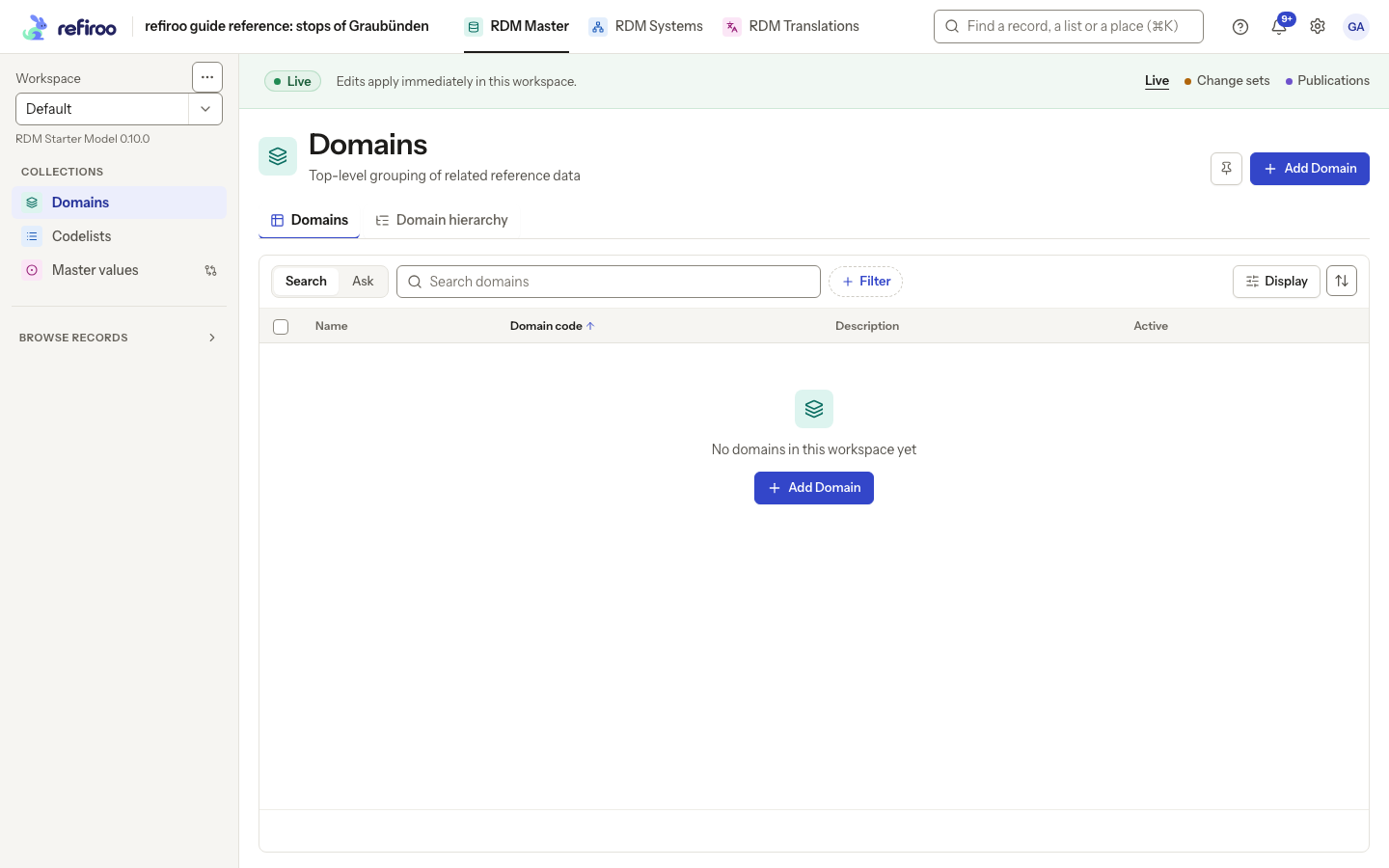
Above: RDM Master in the Default workspace has Domains, Codelists and Master values collections. Domains and Domain hierarchy are two views of the selected collection. This workspace has no data yet.
RDM Systems
Section titled “RDM Systems”This application holds systems, nested system groups and system values. A system value can connect to a master value or represent a domain or codelist. It offers a hierarchy, a mapping grid and matrices comparing codelists or master values against systems.
It demonstrates relationships, hierarchies, mapping grids and relation matrices.
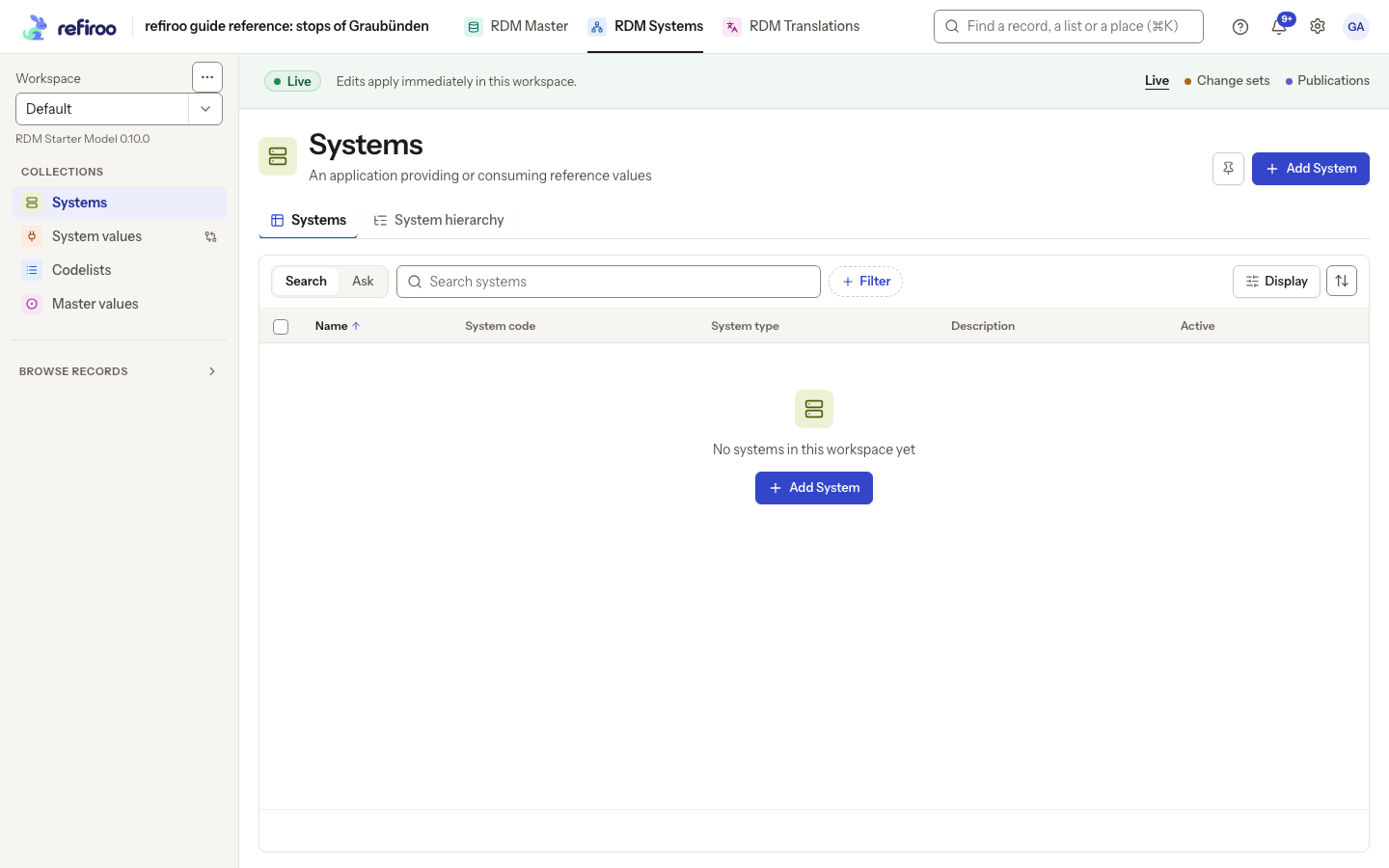
Above: RDM Systems in Default offers Systems, System values, Codelists and Master values. Systems and System hierarchy are visible tabs. The table is empty because this workspace has no records.
RDM Translations
Section titled “RDM Translations”This application holds languages, nested translation groups and translation records. A required owning relationship connects each translation to what it translates. Matrices compare codelists or master values against languages and allow creation and correction of related translations. The model allows only one active translation per owner and language.
It demonstrates records, relationships and relation matrices. See Translations as an example for how those pieces fit together.
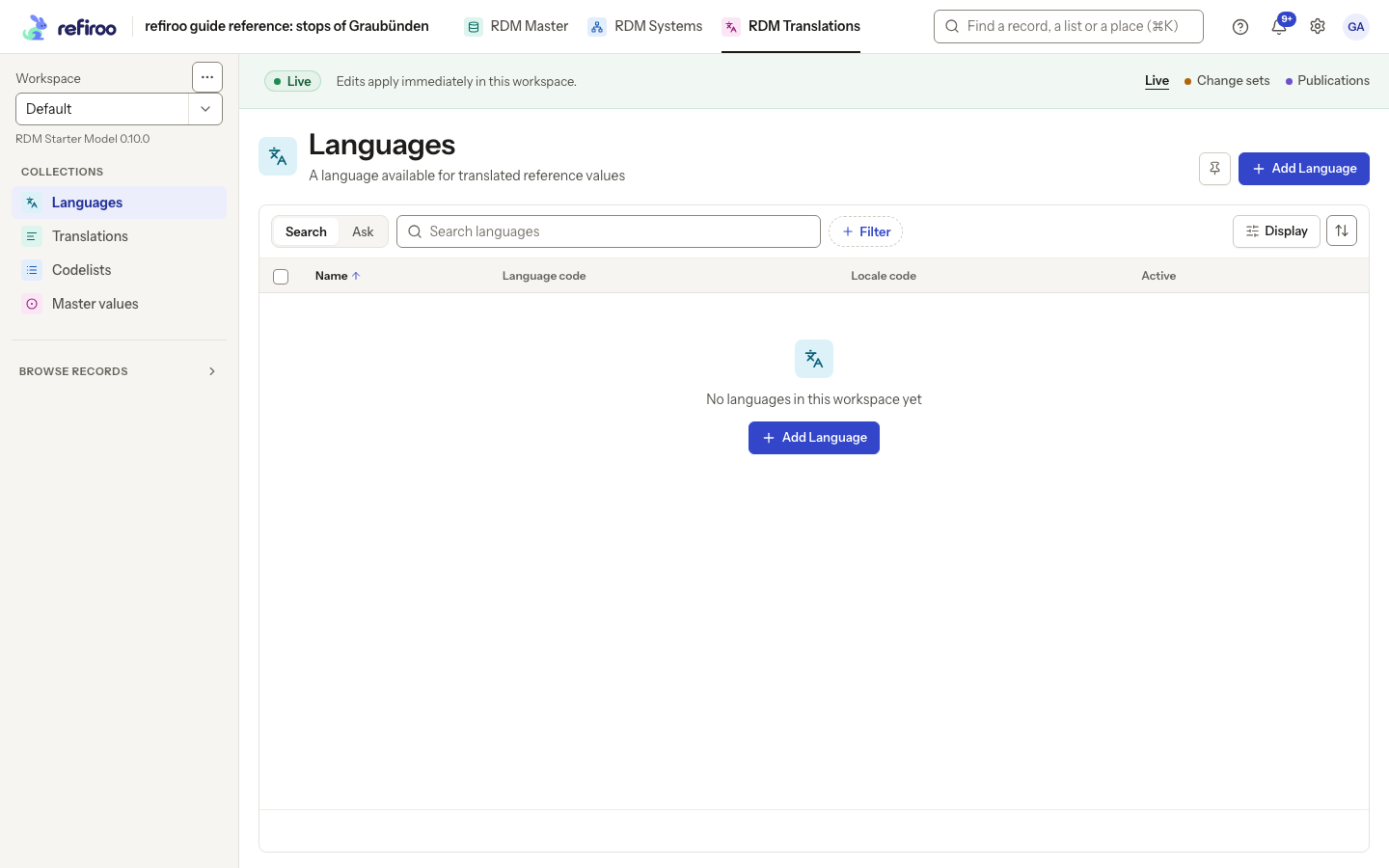
Above: RDM Translations in Default offers Languages, Translations, Codelists and Master values. No languages have been added to this workspace.
All three applications share Live editing, change sets, publications and record history. Access depends on roles and grants, rather than the application name. Differences in their collections and views come from this model’s declarations. For a populated example using the same capabilities, see The example data.
A contract for other systems
Section titled “A contract for other systems”The starter model also declares RDM API, contract version 1. It exposes domains, codelists and master values under public names, with lists of domains, codelists by domain and values by codelist in sort order. Its values-changed event reports master values created, updated or deleted, watching changes to the public code, name, active flag and validity dates. Its object reads include related system representations and translations, and its lookups and batch resolution find records through their own or related identifiers. See The consumer API example for the declaration and a populated example of the same capability. This is an example contract a model can replace or omit. A security administrator grants a client access to it in the intended workspace; see Clients. The model editor holds its definition.
Screenshot data: Source: opentransportdata.swiss, Service Points (Didok), Federal Office of Transport / SBB, snapshot 2026-11-02. Wikidata, CC0. See The example data for sources and fictional additions.